It all Started with Sir John Sinclair’s Statistical Account of Scotland, which stands as one of the most ambitious social research undertakings in European history. When Sinclair published his 21-volume masterpiece between 1791 and 1799, it was followed by the New Statistical Account (1834–1845), and then again with the Third Statistical Account (1939 and 1956), all creating an unmatched blueprint of a nation undergoing rapid transformation.
The information provided was based largely on information supplied by our parish [church] ministers who submitted rich and detailed parish reports on a wide variety of topics such as wealth; social structures; poverty; climate; agriculture; fishing and wildlife; religion; population; schools, and the social habits of the inhabitants of our community.
Today these accounts may be considered a useful source of information about the Rosneath community of the past, from the Age of the Enlightenment to Post-war Britain
The Scope and Method
Sinclair’s initial survey was exhaustive, with the 160-question survey, laying the ground for all subsequent formats. This covered physical geography, soil quality, weather patterns, and agricultural yields. It gathered demographic and economic data including population counts, birth and death rates, occupations, wages, local prices, and emerging industries. Crucially, it recorded social conditions like diet, housing, education, local diseases, and poor relief, alongside cultural details such as traditions, language, antiquities, and the perceived moral character of each community. Persuading nearly 1,000 Church of Scotland Parish Ministers to complete these detailed questionnaires required relentless pressure. Sinclair wrote thousands of follow-up letters, enlisted the help of the General Assembly of the Church of Scotland, and even threatened to send independent observers to write the reports for reluctant ministers.
Why It Is Irreplaceable for Family Historians
Standard genealogical sources, such as Old Parish Registers or early census records, are inherently skeleton-like. They provide a name, a date, a birth, a marriage, or a burial, but offer little context. The Rosneath (Roſeneath) Statistical Accounts flesh out these records by revealing an insight into the living conditions of our community.
If an old register lists an ancestor, such as a Farmer or Blacksmith, the local minister’s account detailed whether farmers in Rosneath were thriving or facing starvation due to industrial mechanisation, weather or the landowner’s activity. When members of the community were no longer in the the parish register, the report explains why, by describing recent land clearances, severe crop failures etc. Beyond major events, these insights into Rosneath’s past capture the everyday reality of community life, from the exact cost of a bowl of meal and the condition of the parish school to the prevalence of disease and the state of local roads.
As a background, the statistical reports had an intent similar to the Doomsday book. Surveys proposed by Sir John Sinclair, Member of Parliament for Caithness, were supported by the Church of Scotland. Sinclair had been aware of the that the ‘Germans’ used it to provide a collection of facts about the political strength of their country leading up to the dissolution of the old Holy Roman Empire. Seeking a similar outcome for Scotland, Sinclair applied “statistical” methods (a fancy new word at that time) to measure what was described as the quantum of happiness. Sinclair believed that by collecting information on the economic, social, and natural resources of Scotland, he could improve the happiness of the population of Scotland.
Replicated here with attached PDFs below, are the statistical accounts for Scotland with related extracts – specific to Rosneath. The extracts provide a wealth of information on our community and their lives, during significant periods of our nation’s history, giving a wonderful insight of our community past. Read them and ask yourself how much our physical and social environment has changed and yet, how much still remains the same. The three ministers involved in the submissions for Rosneath have done a great job, which has endured beyond their lifetime and will provide a memory of our community for centauries to come.
Three Statistical Accounts for Rosneath
The Old (First) Statistical Account, was written by the Rev George Drummond, who provided some of the best contemporary reports of life, crucial to the understanding of our community and Scotland on the eve of the Scottish agricultural and Industrial Revolution; the French Revolution and Napoleonic wars .
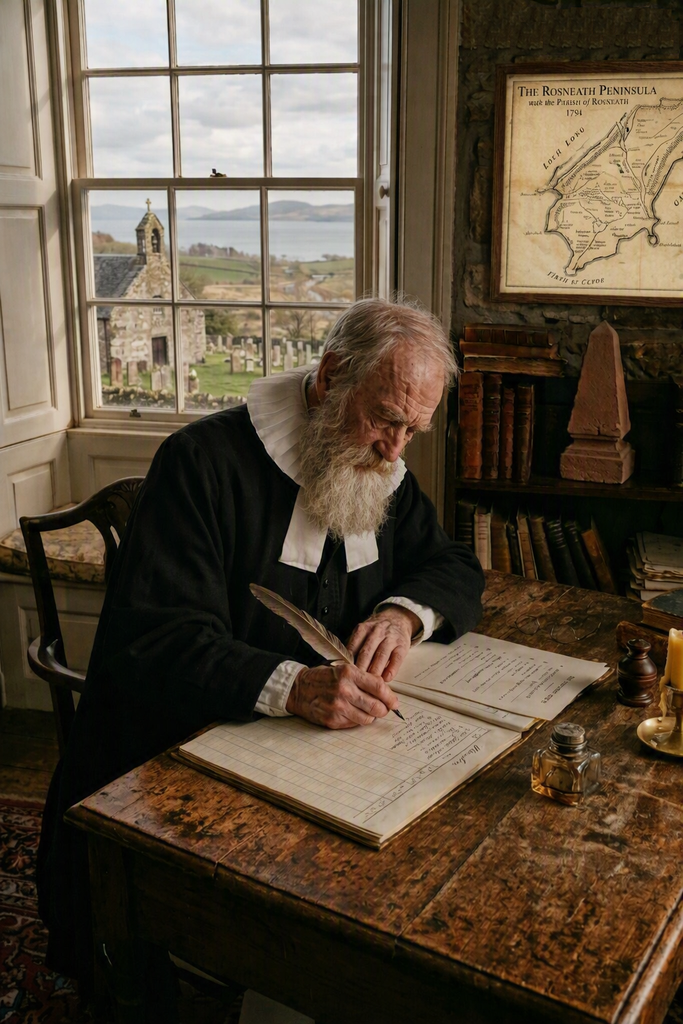
The Old Statistical Account, was published between 1791 and 1799 with the Rosneath section covering up to 1790. It was submitted by the Rev. Dr George Drummond.DD., who ministered in Rosneath between 1766 and 1819.
In Tales of the Gareloch, we read:
Dr Drummond seemed well suited to such a parish as Rosneath. With his jolly easygoing ways, he entered into all the merrymaking, which took place, and these were by no means rare.
Dr Drummond was responsible for the rebuilding of the church in 1780 and he died in 1819 in the 82nd year of his life and 53rd of his ministry. He was described as, ”A gentlemen of high respectability, deep erudition and eminent worth”. His grave the (red sandstone pinicle) can be seen in the old churchyard close to the old church ruin.
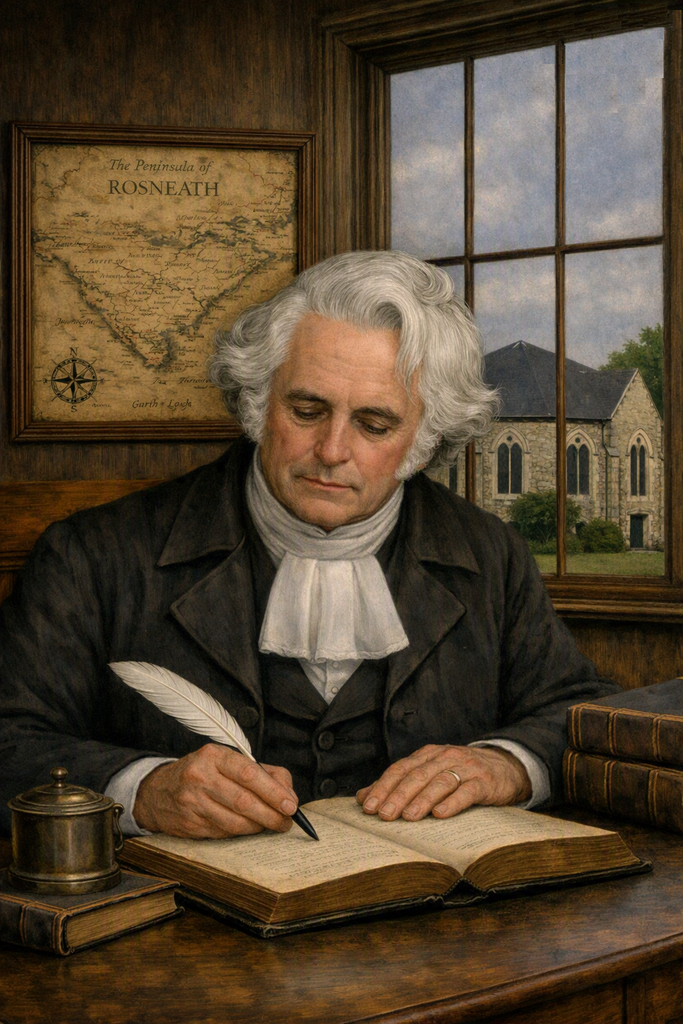
The New Statistical Account was published between 1834 and 1845, with the Rosneath section dated May 1839. It was submitted the Rev. Robert Story, who ministered in Rosneath between 1819 and 1860.
Dr Story is considered to be the father of the present St Modan’s Church. He was responsible for the building of the new large Victorian Manse (now the private house, Easter Garth) behind the church. He also did much to reform the dour worship of the time and was responsible for commissioning the beautiful new church building. Dr Story is buried in the old graveyard close to the Manse wall.
Third Statistical Account, was started after World War II. It was a more rigorous and wide-ranging record than its predecessors, covering industry, transport, culture, and demographics. Although submitted between 1950 and 1955 by Rosneath minister Rev. Dr. Cameron Dinwoodie Ph.D. (who ministered in Rosneath between 1939 to 1956), the entry took a more secular tone while still reflecting local religious life. Across Scotland, the Third Statistical Account was a massive undertaking, taking over forty years to complete before its eventual publication between 1951 and 1992.
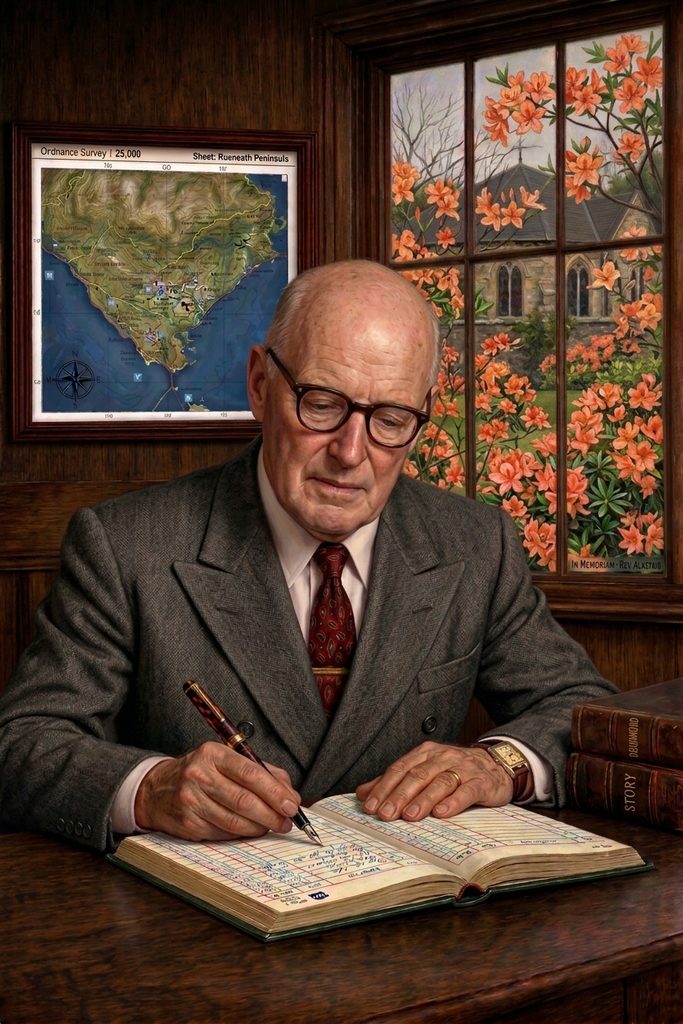
taking the congregation through the years of the Second World War.
Rev. Dr. Dinwoodie was very much the unspoken Minister of Rosneath, and partially disabled, although none of this distracted from his ministerial duties, where he travelled the length and breadth of the community, almost exclusively by bus to attend to the needs of his parishioners. Unbeknown to many in the community today, Dr Dinwoodie was not just a highly respected minister of the Church of Scotland, but surprisingly also of a giant of Science and Mathematics. Society and the expressions we use today changes over time, but in the days before the widespread use of the term to describe sophisticated electronic machinery to undertake complex calculations, Dr. Dinwoodie as a gifted scientist and Mathematician was known as a ‘Computer’. His application and significance in all aspects in his life, is confirmed in the following tributes from the Scottish Journal of Theology and The British Astronomical Association .
Futher Reading
The Statistical Accounts of Scotland Online
Statistical Accounts of Scotland