
In the small village of Rosneath, Argyll and Bute, Scotland, just inside the entrance to the ‘New Graveyard’, is buried the Reverend, Dr. Cameron Dinwoodie Ph.D., F.R.A.S and his wife Ann Bullen.
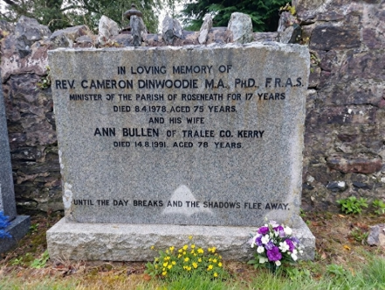
Rev. Dinwoodie Ministered in the Parish of Rosneath from 1939 to 1956, supporting the congregation through the War time construction of Rosneath during the Second World War, then notably contributing to the Rosneath section within ‘Third Statistical Account of Scotland’, (1950 to 1959)’.
Rosneath & Astronomy
Rev. Dinwoodie ministered during a transformative era of local expansion, guiding a rapidly shifting congregation through the crucible of wartime and the dawn of the Cold War. As the community grew, his pastoral care extended across a diverse flock of traditional agricultural families rooted in the land; residents occupying the historic nineteenth-century villas born from the Duke of Argyll and Robert Thom’s “feuing” estates, and a new wave of visitors living in caravans scattered across the grounds of the recently demolished Rosneath House (Castle). Beneath this changing social landscape lay the steady influx of naval personnel and their families, all searching for local housing amidst the early expansion of the nearby Faslane Naval Base, following the arrival of HMS Adamant.
To the residents of the Rosneath Peninsula, the Rev. Dinwoodie was best known as the faithful, unspoken heart of the local parish. Despite living with a disability that could have restricted his mobility, he refused to let physical limitations impede his pastoral calling. Through the War and post war years, at a time when private cars and petrol where limited, he became a familiar, comforting presence aboard the local buses, traveling the length and breadth of the community to visit the sick, counsel families, and attend to the daily needs of his parishioners. Many knew him only in his clerical collar, he was simply a dedicated country minister.
However, beneath this quiet pastoral routine lay one of the sharpest mathematical minds in modern Scottish astronomy. Dr. Dinwoodie was a leading figure in computational astronomy. Society and the expressions we use today change over time, but in the days before the widespread use of the term to describe sophisticated electronic machinery to undertake complex calculations, Dr. Dinwoodie as a gifted scientist and Mathematician was known as a ‘Computer’, long before the advent of modern electronic computing. This was a field that required vast, painstakingly accurate mathematical calculations.
In an era where faith and empirical science were often viewed in opposition, Rev. Dr. Dinwoodie provided that bridge between Faith and Science. He quietly exemplified their integration, devoting his days to pastoral care and his evenings to mapping the mechanics of the heavens.
Dr. Dinwoodie’s primary expertise lay in Celestial mechanics and observational astronomy, where he specialised in tracing, modelling, and predicting the precise trajectories of celestial bodies. Working largely in isolation, he predicted the returns of comets with remarkable precision. He never kept science and theology in separate compartments. For him, the elegance of physical law and mathematical precision reinforced the rationality of creation rather than challenging his faith. Around this time, he also began his long association with the Scottish Journal of Theology.
Langholm and the Space Age (1956–1970)
In 1956 Rev. Dinwoodie accepted a call to the parish of Langholm, Dumfriesshire, where he served until his retirement from full-time ministry in 1970.
In 1959 he was persuaded to take charge of the British Astronomical Association (BAA) Computing Section, initially agreeing to serve four or five years until a younger successor could be found. He instead led it with distinction for fifteen years.
Dr. Dinwoodie led the complex mathematical task of calculating and verifying the precise orbits of newly discovered comets, asteroids, and celestial phenomena. He was also honorary President of the Dundee Astronomical Society, which was granted in recognition of his immense contributions to observational science and community outreach. His Directorship of the Computing Section of the BAA and skill in orbital calculations earned him national prominence within the astronomical community.
His directorship coincided with the dawn of the Space Age, a period when public interest surged and BAA membership more than doubled. During this time, he managed a nationwide network of amateur computers and prepared and edited the BAA Annual Handbook, which became essential reading for professional astronomers worldwide. His contributions earned high praise, with Professor Hermann Brück, Astronomer Royal for Scotland, citing him as a distinguished amateur, and the Royal Astronomical Society honouring him with a Fellowship.
Adapting to New Technology
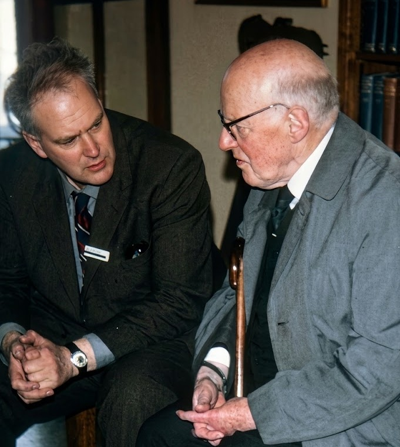
Dr. Dinwoodie’s tenure also spanned the shift from mechanical calculators and trigonometric tables to electronic mainframes. Anticipating the change early, he steered his team towards refining orbital data through precise observation, work requiring human judgement that machines could not replicate. His academic legacy and literary contributions were instrumental in shaping standard astronomical reference texts used by students and researchers across the UK, where he was tasked with revising, expanding, and editing core scientific works, most notably Martin Davidson’s seminal text, Elements of Mathematical Astronomy. His revisions helped bridge complex spherical trigonometry and orbital dynamics for successive generations of astronomers.
Retirement and Legacy (1970 onwards)
After retiring in 1970, Rev. Dr. Dinwoodie and his family moved to St Andrews, Fife, where he took part in local scientific circles in St Andrews and Dundee.
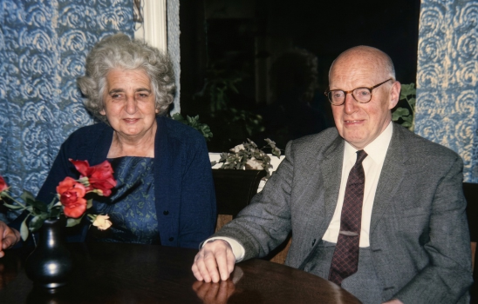
In 1974, on stepping down as Director of the Computing Section, Dr. Dinwoodie received the Walter Goodacre Medal, the BAA’s highest honour. Known for his kind but firm insistence on accuracy, he famously reminded colleagues that even electronic calculators were not immune to human error.
Rev. Dr. Dinwoodie stood in a long line of Scottish minister-scientists who regarded the study of nature as a natural extension of their theology. Through his ministry, mathematical precision and humble service, he left an enduring mark on both his church and the astronomical community.
The Rev. Dr. Dinwoodie passed away in March 1978, followed by his beloved wife, Ann Bullen, in 1991. Their shared wish to return to our community for their final rest, stands as a beautiful testament to their deep affection for this place and its people.
He spent seventy-five years anchored to the earth, yet his mind never truly left the heavens. Though the calendar marked his passing in 1978, he left this world with the unspent wonder of a young man, his eyes still wide with the same curiosity that first drew him to the cosmos. For decades, he mapped the firmament, deciphered the movements of distant celestial bodies, and listened to the silent rhythms of the night. It is only fitting to consider that when his earthly journey reached its end, it was not a final rest, but a grand return. He did not vanish; he simply dissolved back into the cosmic ocean he spent a lifetime studying, becoming part of the very light, he so lovingly measured.
Come to our beautiful village sometime, pay him a visit and share a few thoughts at his grave.
Returning to the Deep Night
Seventy-five revolutions mapping the mechanics of the sky
Learning the language of heavens passing by.
Yet when he left us in the spring of ’78,
He went with a heart the years could not weight
A Minister’s wonder, an astronomer’s gaze,
Unbound at last from the counting of days.
He who once traced the trajectory of Mars,
Had crossed the great threshold to sleep with the stars.
No longer an observer on this heavy earth,
He returns to the cradle that gave him his birth,
Woven forever in the fabric of space,
A spark of bright starlight in time’s endless grace.
Returning to the deep night,
Until the day breaks and the shadows flee away
TOMOBB 08-04-2024
Newspaper Articles
Extracts from the Helensburgh and Gareloch Times – Thanks to Tony Belk
Tributes
His application and significance in all aspects in his life, is confirmed in the following tributes from the Scottish Journal of Theology[1] and The British Astronomical Association. [2]
[1] https://www.cambridge.org/core/journals/scottish-journal-of-theology/article/rev-matthew-james-cameron-dinwoodie-ma-phd-fras/2082244D675711BC4A0258726A379B8A
[2] https://britastro.org/wp-content/uploads/sites/Cameron Dinwoodie.pdf